
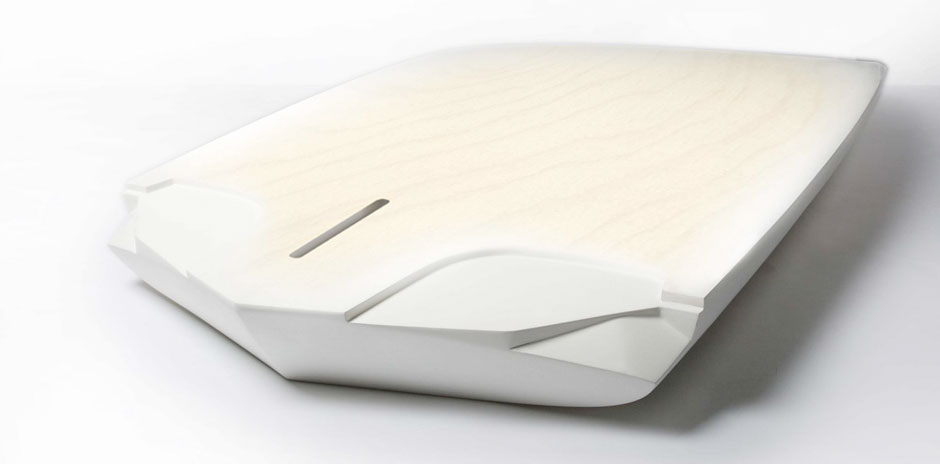
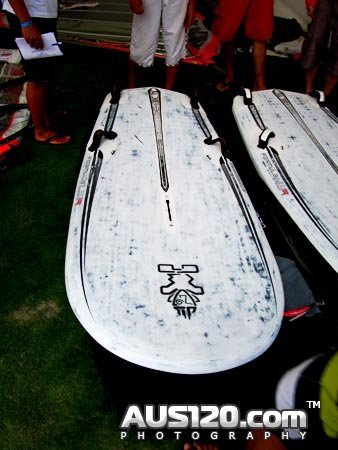
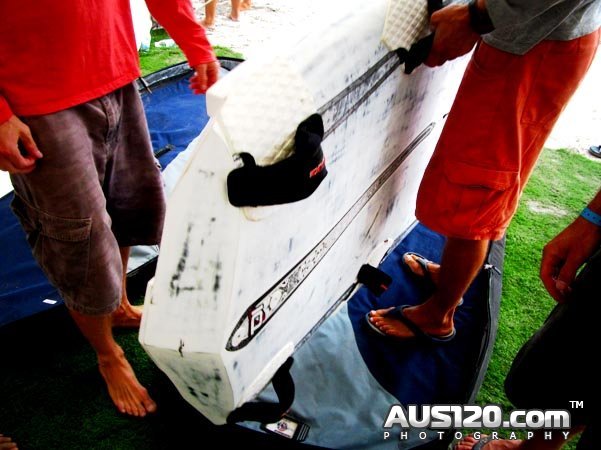
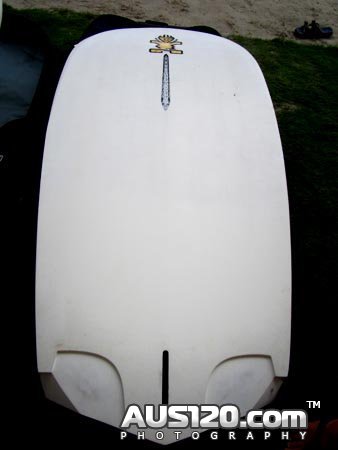
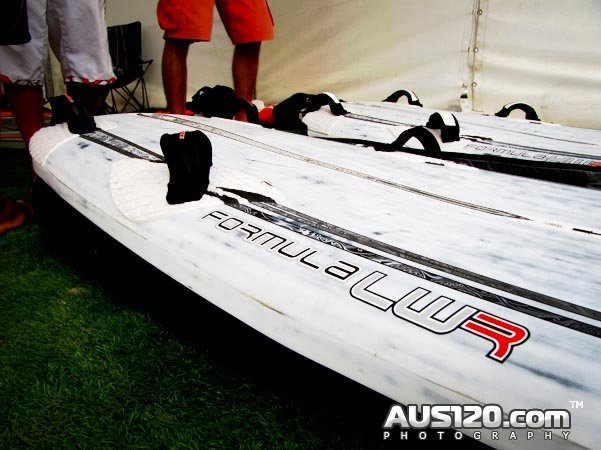
Being the bigger of the formula board manufacturers Starboard decided to cover their customer market this season by releasing two formula boards instead of the usual one. With the board designs fixed for two years (2010-11), for those who aren’t lucky enough to own both, a difficult decision lies ahead to choose whether the HWR or LWR will be the board under your feet this season. Starboard chose to market these boards specifically tailored to different weight riders; heavy and light, simple right? The numerous posts on forums and emails to this author would have us believe the opposite. So to help everyone with their confusion and to find out the differences between these two boards, we sat down with Starboard/Severne teamrider Jesper Vesterstrøm (DEN-111) whose been in Australia over the January period testing the new boards, to find out his take on what people should be riding this season.
Before we start with Jesper’s comments, let’s go through a few things about the boards for those who don’t already know; starting with the names.
HWR = stands for Heavy Weight Racing
LWR = stands for Light Weight Racing
With the below specs of each board, you can quickly see that the LWR has a larger volume and a smaller tail width. Having a larger board for ‘lighter’ sailors essentially started the confusion as you would think, that a lighter sailor would need a smaller board right?
| MODEL | VOLUME | LENGTH (cm) | WIDTH | TAIL WIDTH | WEIGHT (kg) |
|---|---|---|---|---|---|
| HWR | 162 | 228 | 100.2 | 81.1 | 8.88 |
| LWR | 168 | 228 | 100.5 | 78.0 | 9.07 |
Some other things to note about the boards is their development pathways. Essentially, the previous 160 and 161 have been very popular boards with many top riders last season, even more so than the later 162 model. Starboard noted this and took the path of developing two very different boards which each show some important characteristics of their predecessors. Despite the new cutouts and tailshape and slightly different rockerline, it’s fair to say that the LWR is a development of the 160, with it’s ‘looser’ feel and smaller tail for blasting off the wind. As the 160 was popular in windier, choppier conditions, so too will the LWR be. The HWR, is a development of the 161 and 162, capturing a few great features of each board whilst making some certain improvements as Jesper will discuss.
So now to Jesper’s comments …
* * * * * * * * * * * * * * * * * * * * * * * * * * * *
After some training in Sydney I may have some insight in to what board would be best for you to choose…
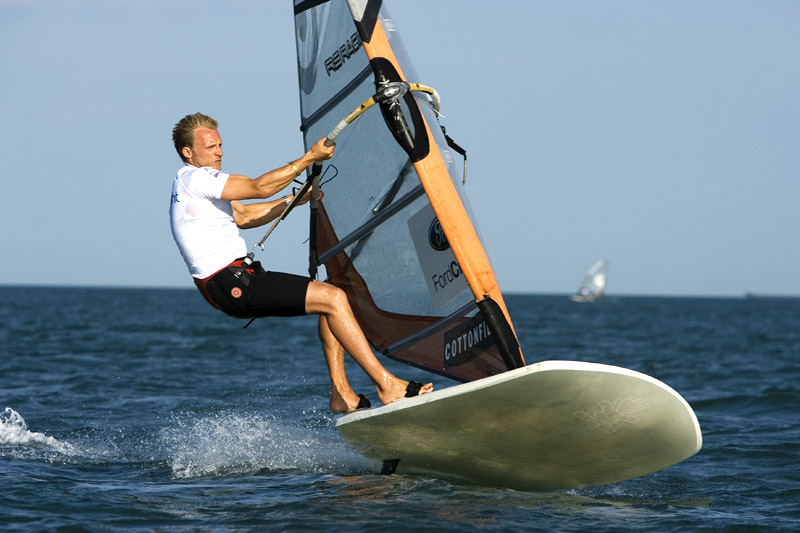
We have all seen that all the boards developed over the last four years are working really well even now. It’s really up to the racer to get the best out of it on the course. Many sailors quickly blame their gear for being slow, but hey, if you are stuck in the 2nd row on the startline – everything is pretty slow right?
I have been testing the HWR and LWR quite a lot in a variety of conditions. Mainly in flat to choppy water – which is pretty much like what the worlds in Argentina will be held in and also what we race in on the international circuit.
The HWR and LWR are two totally different boards, no question about that. The most fun board to ride is the LWR – it reminds me of a slalom board with a narrow tail, round nose and is really just easy to sail. Despite this, I am still choosing the HWR for racing at most events this season!
To put things in perspective I am 189cm tall and 89kg.
The LWR is as I said before, a great board. It will work really well for smaller guys 60-78kg. It rides a lot different than the HWR and depending on the size of the rider you probably want to look in to riding bigger fins in light winds. If the board get’s clear wind it really goes fast and keeps accelerating whilst still being easy. Downwind the board sits high and there is no chance that the nose will ever catch the chop, one can go super deep and fast. If I come to an event where it’s going to be windy each day, I would not make any doubt to register the LWR. The Grand-Prix in Fortaleza, Brazil for example would be the perfect place for that kind of board. Or Łeba, Poland with side/on shore 15-25 knots.
In bigger fleets however, lighter winds and being a bigger rider you definitely want to go for the HWR. Why?! Because this board you can really push to the max. When saying push I mean it really points upwind and you can push on the back leg and it just goes for more angle. If you are stuck in bad air/water there is always a chance where it will become a lot harder on the LWR as you need to go more for speed, especially being a bigger guy. Since everything is settled on the first upwind in most races – you don’t wanna be losing angle and going for speed. I have tried experimenting by getting myself into the worst situation and I can always comeback on the HWR. On the LWR I can too, but to a lesser extent as I need to go for more speed and I lose too much angle.
The HWR takes smaller fins. The tail is powerful compared to the LWR and I am still using 70cm fins on the board at all times. Being a lot wider the board planes really early and you don’t have to bear away too much when pumping onto the plane after tacking or starting.
To summarise:
- If you are +80kg go for the HWR.
- If you are <80kg and you usually sail in light winds, go for the HWR.
- If you live in a place where there is consistent medium winds, like in Sydney where the wind varies from 12-20 knots, go for the HWR.
- If you live in a windier place with swell and chop (like Fortaleza) go for the LWR.
- If you live in a light super wind place, like Florida, go for the HWR, regardless of your weight.
I will be using the HWR mostly this season, but for the windy events, I will be on the LWR.
Any questions, you can drop me a mail; find me on www.vesterstrom.com.



Here is a collection of places you can buy bitcoin online right now.





Great article.
Still a bit puzzled about bigger boards having smaller fins.
Sometimes, the wider tail/bigger board is giving you so much leverage that you push the fin away. On the otherhand, the needed lift is generated by hull and fin and I can understand that a “bigger” hull with enough lift can use a smaller fin.
Off course, there isn’t only fin length and width that influence the lift and here all the board shape caracteristics (scoop-rocker, bottom shape, rails,…) will have an effect making that FW board brand X behaves different then FW board brand Y.
Since we are at the start of a 2y cycle, it will be again an interesting testperiod ahead.
Luckely, I’m prepaired with different fin alternatives.
Hi Koen,
Cheers for reading.
You’re right, lot’s of factors influence the lift and ride of the board; that’s why I like to publish the measurements where I can, as some of the die-hards out there can visualise what the numbers will mean before they see the board. Unfortunately, I don’t have enough access to these two boards to get them measured for this article (maybe one day soon).
I think Jesper means that the HWR creates a lot of lift and rails easily without the need for a massive cutdown fin, whereas the LWR with its smaller tail might just need a bit more power in the light end of the wind range, hence the need for bigger fins.
In my short experience testing the boards (I unfortunately, didn’t try out the LWR in super light winds with a 12m as yet), I found both boards were easily powered with good 70cm fins and I used a 73cm cutdown on the HWR which was nice even in strong winds. It certainly doesn’t need to go bigger than 73cm cutdown as opposed to the JP and F2 boards which I “think” will need +76cm in the light winds…
I tested both boards for 2 weeks. Loved the LWR especially downwind in 20+knots, but decided the HWR would have a better overall race performance for me at 180cm – 83kg’s.
I also decided for the HWR for the extra advantage in light wind and packed starting lines.
I am 79kg. The board feels great with CR 70cm XS v.2 from http://www.F4 Fins.com
Hi i am 62kg and would be sailing in windrange 10 to 22 knots. What would be the recommended board size.
Thanks
Jmarc
How does the HWR handle the long rolling swell like we can get in the Chesapeake bay even in light winds.—thanks for the great web site.
Tom C
@ Jean-Marc Gardette – I think at your light weight you can easily go with the LWR.
@ Tom C – we just finished the FW Oceanics at a spot with long rolling swells just liked you described. Both the HWR and LWR ride with their nose high and rail quite easily which is what you need to keep on the swell. If your board rides flat in the light winds you can sometimes get stuck on the crest of the wave, then you stop dead. You need a powerful fin and a board that rails to be fast on big swell in light breezes. The HWR should be perfect for this and with the slightly wider tail should allow you to run a big powerful fin to get over the swell.
Hello Sean and Koen,
The remarke about needing a bigger fin on the LWR then on the HWR also pussled me a lot. Up until now I thought and experienced that the wider the tail the bbigger the fin I need to get the correct leverage. With a smaller tail the bigger fin will stall the board sooner (at least in previous years this was true for me).
Maybe yoy have extra info why on this particular shapes the smaller tailed board needs a little bigger sails?
The F2 Z needs big fins as where the older starboard (the 160) with smaller tail do better with smaller fins. For me this was a rule up until now?
Sean, will you do more previews on the new boards on this website? Any plans on that? Would be interested a lot….
thanks
sorry for the typo’s in the previous reply:
“Maybe yoy have extra info why on this particular shapes the smaller tailed board needs a little bigger sails?”
Should be:
“Maybe you have extra info why on this particular shapes the smaller tailed board needs a somewhat bigger FINS?”
Hi, i’m an internationally renowned FW racer. My ’10 gear has more carbon content than De Beers boutique.
But I have this “friend” who’s looking at a second hand 2002 Starboard 156 for recreational sailing and implored me for some advice.
Since I sell my gear off immediately after wetting it, i know very little about the used market.
He said the board looked fine, but had a large painted over section near the fin box.
Do the administrators of Carbon Sugar have any advice on what to look for and avoid in boards this old?
@Gybes McCabe – I wouldn’t be too worried about that. It’s probably just been repaired around the fin box.
Probably the biggest concern with older boards is water in them which leads to delamination eventually. On the starboards with the wood deck you can usually see discolorations in the wood where the water has seeped through the veneer. Otherwise is you can weigh the board and it is unusually heavy (might have to consult the starboard archives for the correct weight) – ie, +1kg weight then it has probably had water in it at some point.
That being said there’s plenty of guys here in Aus using boards older than that still going strong for 8-10 years. A good formula board looked after should last 10 years I think.
Sean,
I was interested in your comments regarding the discolouration in the veneer. This has happened to my board and I was wondering what could be done to prevent further ingress of water – do you have any suggestions?.
Ben
Hi Ben 555 – how old (or what model) is your board?
I assume we’re talking about Starboards as they are the only ones with this problem. There’s not a lot you can do… the older the board, the more they will discolour. To some extent, I believe that is one of the factors why Starboard went to the painted wood-carbon construction on this year’s boards. It’s to do with the UV rays on the board.
Now, the other thing you can get is water stains, where the water is getting through the thin layer of glass over the top of the wood deck. To combat this, you can use an epoxy wood-penetrant, which will stop it getting worse, however, they will make the veneer look even darker!
“clear penetrating epoxy sealant” … that’s the product I was talking about in the previous comment. The one I have is made by Smith&Co in the US. I assume there is equivalent products around…
I’ve been sailing on a f2 board since 2007, now, I’m thinking to change to a starboard… If I do it, for sure I’ll go for the HWR because I’m 93kg but, what fin should I use with the HWR to winds between 7-15kts and 15-20kts??? Now I just have an IFJU 70cm XS designed for light winds.
Fernando
Currently sailing an Apollo which I use in very light winds. Before that I sailed a 158 that I really enjoyed for blasting around in winds up to 20 knots. I felt like it had a very free, bright ride compared to the Apollo, so that is what I’m looking for in the new board. I weight 83 kg and where I sail there is no formula racing, so I’m inclined to get the LWR.
@ Fernando – surely the Ifju will be perfect even in strong winds. We’re finding more and more now that the good fins can be used in nearly all conditions, reducing the amount of fins we need. Try it in strong winds with the HWR, I think you’ll be suprised!
@Ray Timm – Cool! I never got to sail the Apollo as they weren’t too many imported down here in AUS. If you’re not racing, but want a light/medium wind blaster then definitely the LWR is the way to go. It has a much smaller tail than a lot of the other FW boards on the market and fairly radical vee/concave much like the Gaastra/Drops boards this year which gives it a nice ‘loose’ feeling which is really nice and comfortable off the wind and on reaches; and also makes it very friendly in strong winds and big seas. It’s a sweet board.
Thanks for your answer Sean, but I’m still thinking about what board I’ll buy this year between SB HWR, JP or Patrik D.. Maybe I’ll wait for more competitions to see what happens hehehe.
@ Fernando – my take so far is that the PD and JP boards have better upwind potential with big fins/sails with a bigger rider, however they are more technical to ride. The Starboards will suit all riders light or heavy…
Hy Sean , congratulations for this WEB SITE (look at the size ;)..).
Is a reference for me in the formula tunnings and tecnique.
I’m planing to change my old 2005 starboar 159, for a new HWR, but not sure at all.
The 159 works very good, is the hwr better?
Usually sail in a 10-16 knots with a 11mts sail , and a spot with a lot of chopy.
Is relly beter in low winds the 2010 hwr or the 159 is good too?
Regards!
Hi Dani,
Thanks for checking out my site!
The HWR is definitely a better board; but the question is “how”
much better and is it worth the upgrade?
Each year, generally speaking, the tail-widths of the boards have increased and (I haven’t got any specs of the 159 handy) I believe there is around a 5cm difference in tail width between a 159 and a HWR, measured at the one-foot-off mark.
What the extra tail width gives you is:
1) more leverage – so you can hang on to a bigger sail longer and run a bigger fin
2) more control – as part of the extra leverage, you’ll actually get more control in stronger winds as the extra leverage lends itself to keeping the board more in control when you get powered up.
The HWR has quite a refined body shape for the starboards and has finally put to use some concave and a new cutout shape which makes the board a lot more friendly to use.
That all being said, the 159 is still a great board and if you gave it to a top sailor, you’d probably find the performance differences are not as big as you think. Only “small” improvements have been made each year.
If you can get the HWR at a good price I think you will enjoy it a little more than the 159 for the above reasons and also in the lighter winds around 10 knots the board should feel a bit “looser” than the 159 and more comfortable …
Hope that helps! Let us know your experiences if you decide to get a HWR.
Thanks a lot Sean, i take your words in my mind and i get a 2010 hwr, but better i next season.
Y buyed a slalom Manta 69 this year. 😉
Regards!
Sean, if you were a heavy sailor in a light wind place what would you choose: JP formula or LWR? ( these are the options that I can afford here )
@ Fernando – definitely take the JP !!!
While I did like the LWR the first time I sailed it; after testing it a bit over the year I can comfortably say it’s just not in the ballgame compared to the other boards on the market. I think it’s simply just not wide enough in the tail. I haven’t got specs in front of me but I would guess the JP is 8-10cm wider at the one-foot-off mark! That is A LOT!
The JP is a great board. Might be a little on the big side for a little guy as it’s pretty wide and likes a powerful fin, but for a heavy sailor in light winds it’s probably the best board on the market!
It likes to run a 12m in light winds though… 11m may be a little small; needs a lot of juice to get the best out of it.
Thanks bro, for your answer… I’m almost buying the JP but, the only pro that I saw using it, is Antoine… So, thats why I’m looking for more information on the internet about this board…
Sean,
I just bought the JP and I was wondering where I can find some tuning tips for it… Do you know some like mast-foot and footstraps positions or anywhere I can find it?