
The rumours were in fact quite true… Gaastra planned to join the formula board market late in 2007 and delivered to their every word with the release of the Gaastra Vapor 2008/09 FW board. To comply with the ISAF regulations of a minimum production run of 10 boards, Gaastra has already produced the first 10 Vapors and I have been lucky enough to get my hands on one (number 004 to be exact). Enjoy a short review of the board and some background information on its development from my talks with Steve Allen and others involved with the board.
Background Development
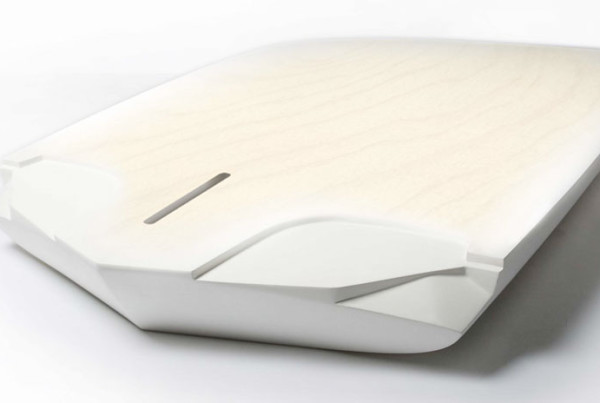
Arriving in Poland in August 2007 to train before the Allegro Cup in Leba, I caught up with Steve Allen and his Polish training partner Hubert Mokrzycki (POL-25). I had heard whispers of Tabou bringing out a formula board for 2008 but I was still suprised to find Steve and Hubert with 2 prototypes of the new board out on the beach. Despite the Tabou footstraps, it was completely blank of graphics and from first view looked a lot like a Starboard 160. The cutouts being the only visual difference; one board with the Starboard cutouts and the other with some deep F2 looking cutouts.
Steve had been riding the Starboard 160 for most of the season (see here why he used the 160 and not a 161) and had wanted to make some improvements beginning with modifying the nose shape and also a slight difference in the bottom shape. Suprisingly enough, from what I could gather there were only these 2 prototypes made, which is a stark contrast to Starboard who usually boast an incredible amount of prototypes tested to come up with their new boards. They tried both cutout shapes but found the Starboard ones to be better than the F2 type. Also note that Steve and Hubert did the entire development on this board (Ross Williams wasn’t included in the development it seems).
From what I was told, Steve’s first use of the production version was during the FW World Championships in Brazil. Hubert informed me earlier that month in Poland that they had decided to brand it as a Gaastra board, to offer a full racing rig/board package and also a racing board as such didn’t fit with the brand-persona of Tabou.
Sailing with Steve earlier this week in Australia he tells me that in early testing with the new board in Brazil, it was faster on all points than the 160. He also volunteered that others who were testing the new 2008 162 had found it to be no faster than their 160’s. Take that with a grain of salt I should think…
Shape
Here are some measurements of the Gaastra Vapor, compared with a Starboard 161.
Gaastra Vapor:
- 30cm off (1ft off) – 5mm vee; 7mm concave
- 90cm off – 11.5mm vee; 5mm concave
- 120cm off – 13mm vee; 7mm concave
- 40cm from front – 14mm vee; 9mm concave
- Width at 30cm off – 813mm
- Mast-track (from back) – 1260mm
- Mast-track length – 170mm
- Finbox (from back) – 90mm
- Flat (from back) – 600mm
- Cutouts 14mm at centre
Starboard 161:
- 30cm off (1ft off) – 0mm vee; 1.5mm concave
- 90cm off – 4mm vee; 4.5mm concave
- 120cm off – 19mm vee; 4mm concave
- 40cm from front – 14mm vee; 1.5mm concave
- Width at 30cm off – 807mm
- Mast-track (from back) – 1267mm
- Mast-track length – 170mm
- Finbox (from back) – 90mm
- Cutouts 10mm at centre
So you can see quickly that the Vapor board is slightly wider in the tail and has a little more vee and concave towards the front – actually the concaves continue right into the nose of the board. The Vapor also has a little more rocker (about 10mm vs 7mm in the 161). The mast-tracks and fin position are exactly the same however.
Ride
This board is a very similar ride to the two previous Starboards (160, 161) in the sense that you can just jump on it, put any fin in, put the track anywhere and just go sailing. I always felt the F2 boards required a little more finesse in your trimming and technique which made them a more technical ride (although still very fast). This board is very “point and shoot” and doesn’t require constant rail pressure or footing off for speed to keep it trucking upwind; making it very easy to tune!
Initially, the new thinned out nose was something I was interested in really testing out when I sailed it for the first time in windy conditions (+25 knots) at Redcliffe, QLD. For those who don’t know where Redcliffe is, it is by far one of the most gnarliest spots I have ever sailed formula at and happens to be my home spot. Think 3-4m swells that are extremely close together and steep as well as few turtles, sharks, dolphins and crab-pots make this an interesting place to test gear – however it boasts some of the most consistent winds (direction/strength) on this side of Australia. I’m not a fan of chicken straps (as you’ll see below) so I took the board out on this particular day to try and see if I could catch the nose downwind!
About 7 waves in a row I lifted my back foot and kicked the board downwind off the top of a swell to try and dig it in (don’t try this at home kids!). I’ve done this a few times on a 161 and subsequently broken booms, fractured elbows and have had a NP boom logo imprinted into my shoulder as a result of catching its nose in +30 knot winds with big seas! The Vapor doesn’t even look like catching…
On the 8th wave I did manage to aggressively sink the nose under a swell but the board’s shallow entry and ‘boat-like’ V shape all the way to the bow allowed the board to pop out of the water very quickly and lose minimal speed. Downwind, I found the board railing very easily which allowed me to ‘fly-the-fin’ (thank Sam Ireland’s Pro Secrets DVD for that term) downwind keeping the speed and forgetting about the swells in front of me. I believe this board’s strength is its downwind controllability (that’s probably not a word!) and speed downwind.
My only negative in the ride of the board was the rail shape under the footstraps. It is a quite boxy board under your feet and as a result I had sore arches in my feet after 2 hours of hard sailing. Something to get used to I guess, but I never had this problem with the Starboards.
Tuning
I have been running my footstraps in the second back hole and mast-track in the middle or 1cm back for 90% of conditions. I don’t like to move my footstraps depending on wind conditions, but on other boards you can get away with raking your fins further upright by moving your footstraps 1-2 holes further forward to get your weight more centralised over the fin.
- TIP: If you are raking your fin excessively forward (nearly upright etc), don’t move your mast-track forward too early. Despite what you might think, raking your fin more upright actually helps to keep the nose of your board down as it creates more vertical lift at the tail.
This board likes power and I felt comfortable using my 12m Gaastra Vapor up to 12-15 knots (although I would normally be on my 11m in 12 knots in racing conditions) and has a wide, powerful tail which allows you to really drive from your back foot upwind, instead of railing the board by pointing the toes of your front foot in the strap. In windy conditions you can keep the track back (still in the middle) if you have the control as the nose shape does not catch on the swells and rides nice and high downwind, allowing you to pick your lines through the swells and go for speed – rather than dodging the deep swells that look a little scary!
I also noticed upwind, the board kept flat in choppy conditions allowing you to really keep the power on the fin. This might mean there’s more potential to spin-out a fin in choppy conditions if you are not too careful, so the board might require a little more finesse in your sheeting/breathing technique over the swells. In flat water (we don’t have flat water where I live) the board should track nicely upwind.
I’ll deal with fins in a moment, but for tuning purposes the secret to getting the board to fly is to make sure to get the nose free and lifting upwind. Mast-track, boom-height and fin make a difference in this sense. Use a combination of mast-track back, boom higher (try one or the other first) to make sure you are getting the nose out of the water and you will notice the board feels lighter under your feet and more responsive. When using a new-style softer-tip fin (see below for what I am talking about), you will need to run the mast-track further back (1-2cm from middle) to keep the nose free as these fins generate more lift under the tail and seem to keep the nose down – which is slow!
You can trim this board by feel with a bit of practice. Go sailing and try and get your weight back towards the fin with mast-track/boom-height settings and when you feel the board is lighter under your feet and more responsive – that is the fast setting you are looking for (this could probably be said of ALL formula boards, but it was more noticeable to me on the Vapor). Try it. Go for a run with your track in the middle. Move it back 1cm and try again. Try 1cm more downhaul and boom up 2cm… I think you’ll notice the difference… try to keep the mast-track towards the middle even in windy conditions if you can handle it (the board needs the nose high to trim correctly).
Fins
The original prototypes were tested with Hubert’s R13 70 S and R19 70 S– fins and one would assume Steve would have tried his Kashy XXS which he had been using most of the year on the formula tour. I was a little disappointed to hear that the R19 was working well in the board as Hubert’s R19 is an early proto which of course was super-sweet and very soft whereas myself and (probably) everyone else in the world couldn’t get their R19’s to work. However, having a board that works perfectly with an R13 70 S is a great asset as this is by far the most popular fin on the market and one of the easiest to tune. So far I have tested the board with:
- R13 70 S
- R19 70 S-
- Select R07 S (2008 prototype – sorry!)
- Select R07 S- (2008 prototype)
- R13 66 S
- R13 73/70 M
Unfortunately for the point of this review, the Select fins were by far the best in this board. These fins aren’t available to the general public for a few months (my French friends tell me that these fins are now available to order from Select – thanks guys!) however the way these fins work is a good understanding of how this board works…
These Select fins are basically a copy of the Kashy fin’s concept in the sense that they are extremely soft in the middle/tip sections whilst having incredible tortional stiffness (no twisting) to create speed. I’m not entirely sure exactly how these fins work in relation to a standard Deb foil like an R13 (I have some ideas, and might write an article about it another day), however they seem to settle the board on the water a lot more than the standard Deb R13 does and help keep the board trimming nicely downwind. By “settle”, I mean that it keeps the board trimming nicely and prevents the side-to-side cantering that can happen with these modern boards that boast double-concaves. I remember Boogie used to talk about the Starboard boards tilting from side-to-side and that softer fins could help with this phenomenon.
So to summarise with the fins: this is another fantastically adaptable board that should be able to be tuned and get good speed/height out of a variety of fins. My recommendations would be that the best performance will be got out of the newer, softer-tip style fins such as Kashy’s, the new Deb R20 and the new Selects etc. Trimming is the key to getting this board to go fast and a powerful, soft fin will help keep the board railing and combined with a higher boom/track further back will help to lift the nose and reduce the wetted-surface area to go for maximum speed.
In higher winds, I still believe these new-style softer fins work far better and would suggest getting off big fins earlier, maybe down to a 68-66cm (depending on your weight) as this board creates rail pressure very easily and with the wide tail you can easily handle the power of these new fins without too much trouble. An R13 70 S/M will still be a great option in higher winds but I have found I can get better angle out of my R13 66 S in +20 knots as I can keep the mast-track towards the back with this smaller fin and keep the power on it at all times. A 95kg guy would probably do better justice with a 70cm fin in the board in high winds (I am 82kg at the moment).
OVERALL SUMMARY
Positives
- Easy to tune/trim
- Fast and safe downwind (probably due to the new nose and slightly deeper cutouts)
- Powerful tail shape allows use of more sail area and bigger fins in higher winds
- Quality construction and materials (although I’ve only owned the board for 3 weeks! – touch wood!)
- Rails easily upwind and trims very straight (no pitching or side-to-side cantering) with the correct settings used
- Gybes very easily
Negatives
- Full carbon might not be as resistant to heel/foot dents as the pine-wood on Starboard boards
- The name is the SAME as the Gaastra sails (c’mon guys, think of something NEW!)
- Slightly more sharp deck rails than the Starboards – may be a little harsher on your feet on the first ride
- Could’ve been slightly lighter considering the full-carbon construction
Overall I give the board 9/10 and (despite not actually being contracted to ride it whatsoever) it will be my board of choice this season for Formula racing. I’m excited to finally see another option on the market that’s a viable competitor to the Starboard as the F2 boards have not been readily available in Australia the past few seasons and it was starting to become a Starboard one-design class down here!








Very in depth! thank-you.
Hello Sean,
Great atricle on the Vapor board.
Do you also have comparison measurements on the scoop rocker line? You already mentioned the slight rocker on the Vapor but what about the 2 mm point and the 2 cm point on the scoopline? Where is it located on the star 160,161 and 162 and where on the Vapor?
I still think that scoop rocker is basic, and then V and concave have impact on the side to dise movement and lateral movement.
I remember the Mistral DevilII that was also with more concave and V then the starboard. The designer Bruce also mentioned that the concave tested slightly better then the no-concave contra-board.
I owned a DevilII and the rides downwind where great, a lot like you describe the feeling of the Vapor. I still ‘dream’ of those easy and fast rides downwind on the DevilII on my 12m Gaastra And while others where down to 10.5 or smaller, I still was confident on the downwind with this 12m on the DevilII. The years after that i had more and more trouble downwind…… maybe a Vapor is an option??
Again thanks an hope you have some aditional info on the Vapor.
Nice article. Thank you very much!
Some pictures from Leba of prototype with F2 type cutouts:
http://www.vejasgalvoje.lt/index.php?option=com_content&task=view&id=44&Itemid=1
Hi,
at Podersdorf I bought this prototype board from Steve. It`s the serial number 001.
I changed the F2 cutouts to the SB cutouts like the stock boards.
The board is faster at any condition as the SB 160 that I used before. Also planning is easier than with the SB.
For the 12.0 I use a Deboichet R14 with 72cm, and with the smaller sizes an R13 / 70cm.
Thank you for all the tuning tips – everything is working well and I`m very happy with that board.
See you
Christian
Wow, really? That would probably be a really awesome board as the protos usually are much lighter as they skip the paint and cosmetic features which add weight.
Probably a good move to go back to the starboard cutouts, lots of testing proved that with the ‘160-like’ board design, the smaller cutouts worked much better as the big F2 ones seemed to ‘suck’ on to the water which is bad for early planing.
I agree with you on speed re the 160. The Gaastra board is essentially the ‘160 with all the upgrades’ as there is a few features that some would like to change on the 160 and the Gaastra has done just this.
Interesting you use R14, I could never get this fin to work, but if it does for you, great! R13 is always a great fin …
@ JW – I will try to get the scoop rocker measurements over the weekend. There’s also a 162 arriving at my place next week for a friend that I can measure 🙂
I’ve never rode the Devil’s personally, but there’s a few still going strong in the Aussie FW fleets here. I agree, I think boards have sacrificed a lot of downwind speed/control in the search for more lightwind grunt over the past few years. I remember the Fanatic 2003 board (and 2004 one to some extent) was untouchable downwind… been a while since we’ve seen that speed so easily achieved on an FW board.
@ Gintas – thanks for that! Actually I had been searching everywhere for those pics, as it appears they have been vetoed from the Gaastra forum and I couldn’t find them again on WindsurfJournal or anywhere.
My Lithuanian is about as good as my Dutch 😛 … would be interesting to see what the comments are about the board. (Some cool pics from Leba on the site too~!) Cheers.
Sean,
Thanks upfront for the effort.
Do you have Exocet riders in Aussie? Any change on measuring the new exocet? Just curious.
That board is also a look alike form the starboard.
What weight is the Vapor? I find the stars pretty heavy at 9.5 kg……
There are no very special comments, only the first visual impressions.
"Obvious that board is prototype. It has glass bottom and Tabou serial number TB …….01 or so. The first impresion is that 50 percent of the board is SB (front) for good upwind in chop, and 50 percent is F2 (back) for downwind speed. Is 50+50=110? We will se the next year.
General view.
View to the nose bevels.
Back. Footstraps are extremely close to the tail.
Bottom. Fin zone has V.
Experiments with cutouts depth and shape. Cutouts are filled with putty.
Seems that bottom has double concave shape, especially the nose. "
Any additional info yet>?
@ JW – sorry about the delay! We are about to start the Oceanic FW Championships here in 3 days, which I am organising so its been a bit of a stress.
Ok, I just realised you wanted the scoop at the 2mm and 20mm point, but I had it in my mind to measure the 2mm/12mm point so I’m giving you that now…
161:
2mm = 980mm
12mm = 1360mm
Vapor:
2mm = 1010mm
12mm = 1320mm
Not a huge difference, but enough. I don’t own a 160 anymore and also don’t have access to a 162 to measure it also.
I did have a sail on a 162 a few days back and was really impressed. It has an almost identical nose with the concaves all the way to the front (great how both brands can come to the same conclusion without actually having seen each other’s designs – as the original Vapor prototypes did not have this feature). The 162 feels a little stiffer under your feet than the Vapor but that’s a nice feeling actually. I couldn’t really pick the difference in upwind/downwind angle/speed; I think you will be safe riding either board this season.
The Exocet I probably can’t test. There’s only 1 in Australia so far. Its nice looking but in actual fact its not very similar to a Starboard as other’s have suggested. Its a lot thinner in volume throughout the board and looks to have a little less rocker. The big thing about this board is the weight, they are over 1kg lighter than any other board on the market, that’s a great advantage.
As far as weights go, I haven’t got a precise set of scales at my house so I shouldn’t comment on the official weight, but it weighed in at 9.5kg-ish (with straps) which is exactly the same as my 161 and my 160 was 9.2kg with straps. So I think the weights of the Vapors will be acceptable and on par with the Starboards. Haven’t seen any of these new F2’s yet – anyone out there got one and could write a comment ??
Great!!! Fantastic review. When will be avalible one of the Starboard 162 and of the F2 FX ….. and why not of the Lorch Thunderbird F1 (http://www.lorch-boards.de/Thunderbird.26.0.html), Mikes Lab L8 (http://www.mikeslab.com/L8.htm) and of the Exocet Warp Formla 100 (http://www.exocet-original.com/products/warpformula.asp)?
Best regards and sorry about my English.
@ [Acme] – well, I can only review boards that I own and sail.
I reviewed the Gaastra board mainly because:
1) I own one
2) I’m planning to sail it this season
3) They’re new and most likely nobody has sailed one yet; people might like some insight into the board before they order one
If someone wants to lend me a Lorch, F2, Mikes Lab, Exocet, 162 or whatever for 2 weeks then I’ll surely give a detailed review.
I was hoping that by me writing a detailed review it would encourage others to write something ‘indepth’ instead of the hype that each brand attaches to their boards in the press… (not discrediting the brands, but every board is different and needs different setups to trim it).
Thanks for reading anyhow!
Great, great. I look to buy this board for 2008. But do really the Select fins work so good? I cannot believe…
Thanks for the measuring, much appreciated.
JW
Great review!
@ Mikhael – at the time I wrote this review they were the fastest fins I had tested.
Since then I have been trying some new fins from Hurricane and also I have found a very nice R13 from trying many diferrent R13’s. The Select fins were very nice upwind but they were a little uncomfortable downwind. My Select fins were early prototypes and so its possible that Select have worked on this problem and the newer fins are better – would love someone who has one built since December 2007 who could comment on this?!
I am seeking to try as many fins as I can before I come back to Europe again this season so feel free to email me later in the (Australian) summer and I will comment on what fins I have tested.
Cheers!
Sean,
congratulation on your interesting and unique website and thanks for this helpful report. I’m not so much into the racing scene so I’m just wondering, do you or your FW friends have an opinion, which formula board would be the best fit for a light and not so skilled windsurfer? I weigh 62kg (137lbs) and at the moment I only use a 9sqm sail. I tried a 11 sqm sail but I couldn’t sail actively any more. Maybe I will try a 10 sqm later again. I would like to replace my *board 175 from 2001. Sorry for this question, but in a regular windsurf shop I can’t get any advice on this kind of boards.
Regards (and I hope I will see you on the lake of Silvaplana)
Andy
Switzerland
@ Andy – thanks for reading!
The boards have changed a lot since the 175 days so I think you will find if you tried the 10m (or even the 11m again) on a more modern, wider-tailed board you will find it is much easier and less physically demanding.
I always like to recommend people the Starboard boards if they are more intermediate windsurfers. The thing is that the last 4-5 boards Starboard have produced have definitely been the most user-friendly in terms of handling highwinds, gybing maneouverability and early-planing. I always found the F2, Fanatic and Exocet boards a little more technical to sail and took a little more effort to enjoy them.
Since you are not sailing professionally, why spend time trying to “learn” how to sail a board when you can just get one that is easy to sail in the first place!
You don’t need to buy the latest boards if you are not seriously racing (in fact, a lot of Pro’s win races on last year’s boards). I would suggest you buy whatever Starboard you can find later than 2005. So you have the options of the F158, F159, F160, F161, F162.
The reason I don’t pick any boards earlier than this is the F158 was a substantial leap in design/direction from the previous year’s F147 board whereby it was far wider in the tail with more overall board volume. Each year since the F158, the boards have got slightly wider in the tail and thinner through the front. So the ‘newer’ the board out of those options, generally speaking the more user friendly it will be and handle bigger sails better. I would just buy the one you can get at the best price that is floating around second hand (unless you want to buy a NEW board, then a F162 or Gaastra Vapor, Exocet WF08, F2-FXVI will do you fine!).
I imagine there would be plenty of Starboards lying around in Switz or nearby Italy/Germany etc.
Good luck and always feel free to post ANY questions on this site! That’s the whole point of it 😉
Sean
Thanks for your feedback and for sharing your experience with others.
Andy
Thanks!,
Sean, Do you know what kind of fins are the guys using on the Devil. I still have my Devil and would like to see if it is competitive still, but I question what fins will make the board ride in a competitive way.
Thanks
Hi Jose,
Is it a first version Mistal Devil or the Devil II ??
Are you racing against guys on the latest boards? I think you will find your board isn’t as fast as the newer ones as the shapes have changed immensely in 5-6 seasons. Mainly in tailwidth, which is allowing us to use much bigger and powerful fins than ever before.
If you were to put one of these new super-soft cutdown fins in your board, I would think it might crack the finbox!
From memory, guys were using R13’s R14’s in that board but mostly HARD fins, because back then we hadn’t really figured out how to get soft fins to work. What fins are you currently using?
I will do some research about this board and get back to you after the weekend 😉
My Board is a Devil II.
I have a deboichet custom R16 +6 68cm. I use in it. I know a new board will make the world rock, but they are expensive and I have already bought to many slalom boards for the season coming.
Any comments will help.
Thanks
Jose
Jose,
I spoke to a few sailors over the weekend who sailed this board previously. It appears the R16 was the main fin the guys were using on it – so you’re already on the right track.
The general characteristics of the board was it was quite ‘aggressive’ to sail; meaning that the board was quite flighty and you would have to work to keep the nose down in stronger breezes or chop. In lightwinds, it was a nice board to sail because the board always felt ‘loose’ and the nose rode high on the water.
What you could try… Is raking your R16 to +8cm or even up to +9/+10 to try it. What this will do, is help to keep the nose down on the board in a little bit more breeeze and also bringing a fin more upright counteracts the ‘geometric twist’, so you might find you get a lot more power out of that fin by having it more upright.
Most of the guys here were using 70cm fins on the board, so my previous comments are about trying to get more power out of your shorter fin. They were using R16 70 S or S–. If you were to buy a new fin, finding an R16 that is as soft as possible would be a good start.
Try the different rakes on the fin for starters. You can do that by sanding off 1mm or so from the front of the fin-head then ‘kicking’ it forward in your box by pulling the front bolt super tight. Measure the tip of the fin at right-angles to your board to make sure you get the correct rake.
Hope that helps 😉
Sean, Thanks for the feedback and research you did.
My Fin is a R-16 +6 soft.
I am a light weight sailor meaning more or less 175lbs or 75kilos. I will try raking it to rake the fin a few more degrees and try it.
I like this board due to the fact that has very low volume and when it is windy it goes very free and fast downwind. Where I heva the most trouble is when windy it tends to fly out of the water when going upwind. So I guess you find something it did not know how to address.
Thanks for the great feedback.
Jose
Sean, After getting my the R16 +6 68cm Soft fin the board has been the fastest and best upwind ever. Now I can keep the angle with newer boards in the market.
Thanks for the help.
Jose
Sean,
Educational contributions
I just want my Gaastra Vapor Formula Vin better than my current purchase Select Elite R.05 width 70
On offer are a Deboichet s 70 R13 and R13 M
I weigh 100 kg and 185 cm, and sail with the next sail TR3 11m ²
One says I S and the other is to take M
I wanted my final speed boost
My RSRacing 9.8 I am sailing with a Select Ultra 66, and combined shipping almost perfect, both as large wind
Hi Rob,
Go with the SOFT, always. The softer fins are a lot more forgiving in stronger winds and will help you go off the wind better 😉
Hoi Sean,
Thx
Hi Sean!
I see you testing formula HWR and LWR from Starboard. I am interested what fin will bee the best from deboichet.
I am 70 kilos and 167cm . I ride with severne code red 3 11m.
I hear the HWR is more stable but slower, LWR is faster but must keep board from more flying.
I racing, . I think buy lwr board, but I hawe dilema which is beter. I do not like the lwr is 168 litre. Is good for me HWR to?
For now I driwe starboard160 with R13 Medium.
Please tell me, what board is the best for me, and what fin for board.
I ride more on the lake, not to much chopy water, in wind 10-25 knots
best regards from Serbia
Hi Nemeth,
We only have a HWR here in Australia as Chris from VMG Blades was given one early for promotion in Australia. Not sure when the LWR will be available in Australia.
As for fins, I don’t know exactly what to recommend you on the Deboichets as we are testing everything but in Australia. The R20 is probably the best of his range but to be honest, your R13 will work great in pretty much any board, so you could stick with that to begin with as its a good fin for a variety of conditions and easy to sail.
I’ll have to ride them both to confirm this, but I think its possible Starboard might be going the wrong way about marketing these two boards as one for ‘lightweights’ and one for ‘heavyweights’ as it appears to be making the decision confusing for buyers. I think both boards will have potential for both heavy/light sailors as they are just different boards and the volume differences shouldn’t make a big difference. It’s like comparing a Vapor to a 162; neither is better for a heavy/light sailor, they are just different boards with different characteristics that would appeal to either …
I’ll try to post some comments when we’ve done some more sailing on the HWR here.
Thank You Sean for answer, I am werry satisfied with Your great web..
all best